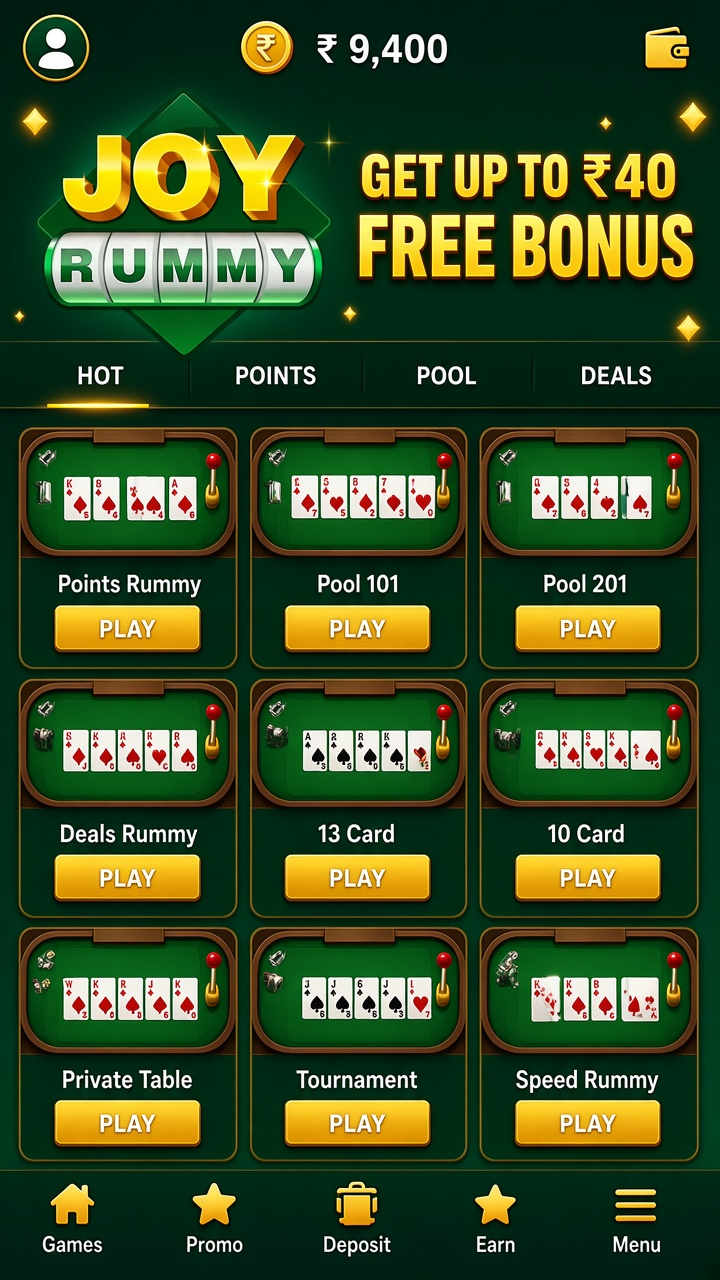

The app in brief
Rummy Joy is built around rummy in its familiar Indian form: thirteen cards, one drawable from either the closed stack or the discard pile, and a hand that must close with valid sequences and sets before a rival declares.
The collection it belongs to shares the same philosophy — surface the numbers, keep the controls close, avoid mystery.
What play looks like
Table information stays visible during play: stake, format and the count of cards left in the closed stack. When the stack runs low the round is forced to a close, so the state of that stack is part of every decision about whether to declare or wait.
Rules screens are attached to each entry, so unfamiliar formats can be studied before the first round rather than during it.
At a glance:
- Joker indicators shown for each hand
- Deadwood count on the result screen
- Valid-declaration checks applied at showdown
Getting to what you need
Menus here are short by design. Fewer options per screen means fewer accidental taps, and the labels are written to be understood on first reading.
The essentials, in list form:
- Favourites row for repeat formats
- Catalogue grouped by format family
- Confirmation step before money moves
- Sound and notification preferences
Verifying your details
Access runs through your own login. Keep the credentials private, use a passcode on the device itself, and sign out on shared hardware — the basics, but they carry the load.
Budgeting a session
No result here is owed. The formats settle as their rules describe, and expectations set anywhere else are the player’s own import.
The fine print on the welcome offer
Newly registered accounts that pass the eligibility check can be credited a ₹40 welcome bonus. The associated terms specify activation steps, game eligibility and the use-by date. The credit lands in a bonus balance, distinct from the withdrawable total.
Payment routes and limits
With UPI and IMPS supported, and a ₹500 minimum per request, the withdrawal flow is a single screen: amount, destination, method, confirm. Standard account checks apply, displayed charges are final, and timing is quoted as an estimate only.