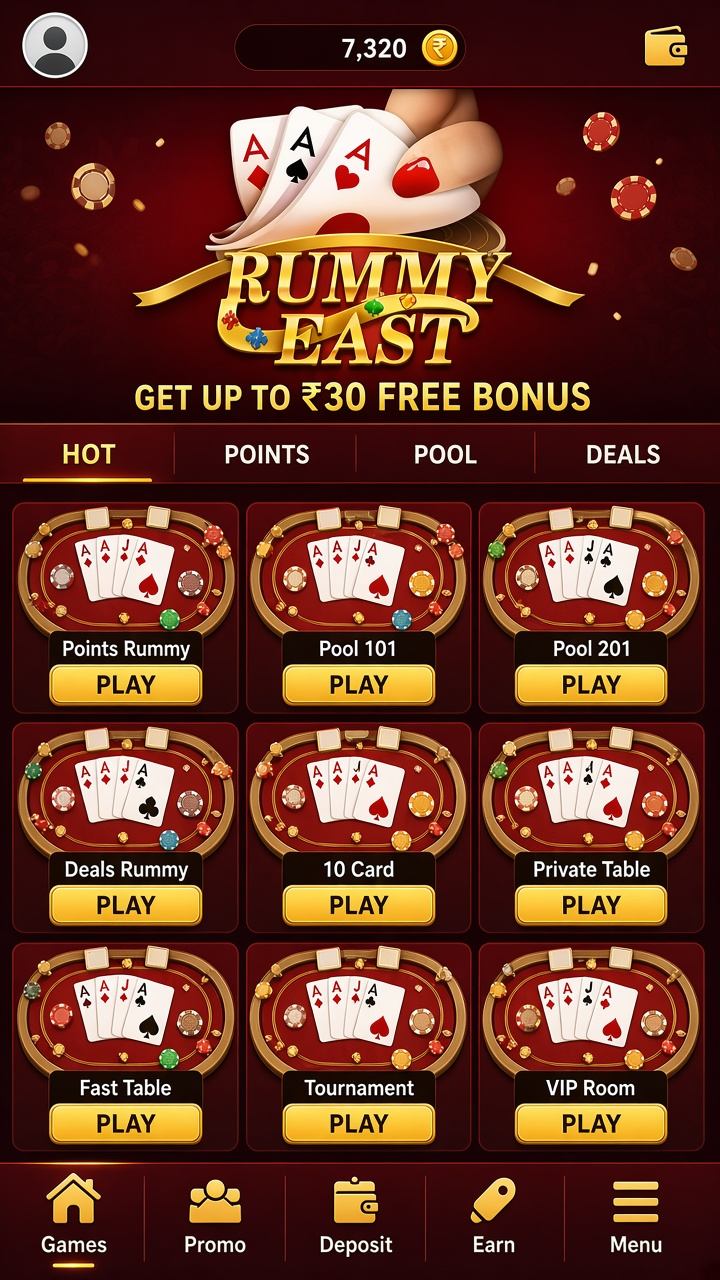

The app in brief
At a Rummy East table the round follows the traditional rummy rhythm: draw one card, discard one card, and watch the pile for signals about what opponents are collecting.
In practice that means the app is less about spectacle and more about the mechanics: what a round costs, how it settles, where the result is written down.
Rules worth reading first
Play begins with a sorted hand and ends with a valid declaration or a fold. Reading the discard pile is the main habit to build: a card that keeps returning to the pile is usually safe to hold, while a card nobody wants tells you what sequences are not being chased.
Points that recur across the app:
- Valid-declaration checks applied at showdown
- Rebuy and leave options at defined breaks
- Joker indicators shown for each hand
On verification
Where the app offers notification preferences, they include transaction alerts — worth leaving on, since they surface money movements you would want to know about.
Pause and review
Two habits keep a session comfortable: a fixed spend limit decided in advance, and a pause between rounds to read the result rather than react to it. Neither costs anything; both change how the session feels.
Opening moves
Start with the DOWNLOAD button, then confirm the install when Android asks. The current listing is 1.3.1, around 32 MB — modest enough for most devices, with some data overhead beyond that.
The short version of the above:
- Choose a format and stake within your plan
- Confirm the install when Android prompts
- Set sound and notification preferences
About the welcome offer
Eligible first-time accounts may claim a ₹30 welcome bonus. The offer’s terms govern how it is activated and where it can be used, and they include a use-by window. Receiving bonus credit is not the same as receiving withdrawable money; the two are accounted for separately.
Requesting a withdrawal
Cash-out starts at ₹300. Choose between UPI and IMPS on the withdrawal screen, where the amount and destination are confirmed together. Bonus-related conditions may hold part of the balance, and the chosen route sets the expected processing pattern.